Reactive
- This is a verdict on the company
- 'I'm not cut out for this'
- Catastrophizing the meaning
- Action delayed by despair
- Endurance feels impossible
Persistence · also: Purpose
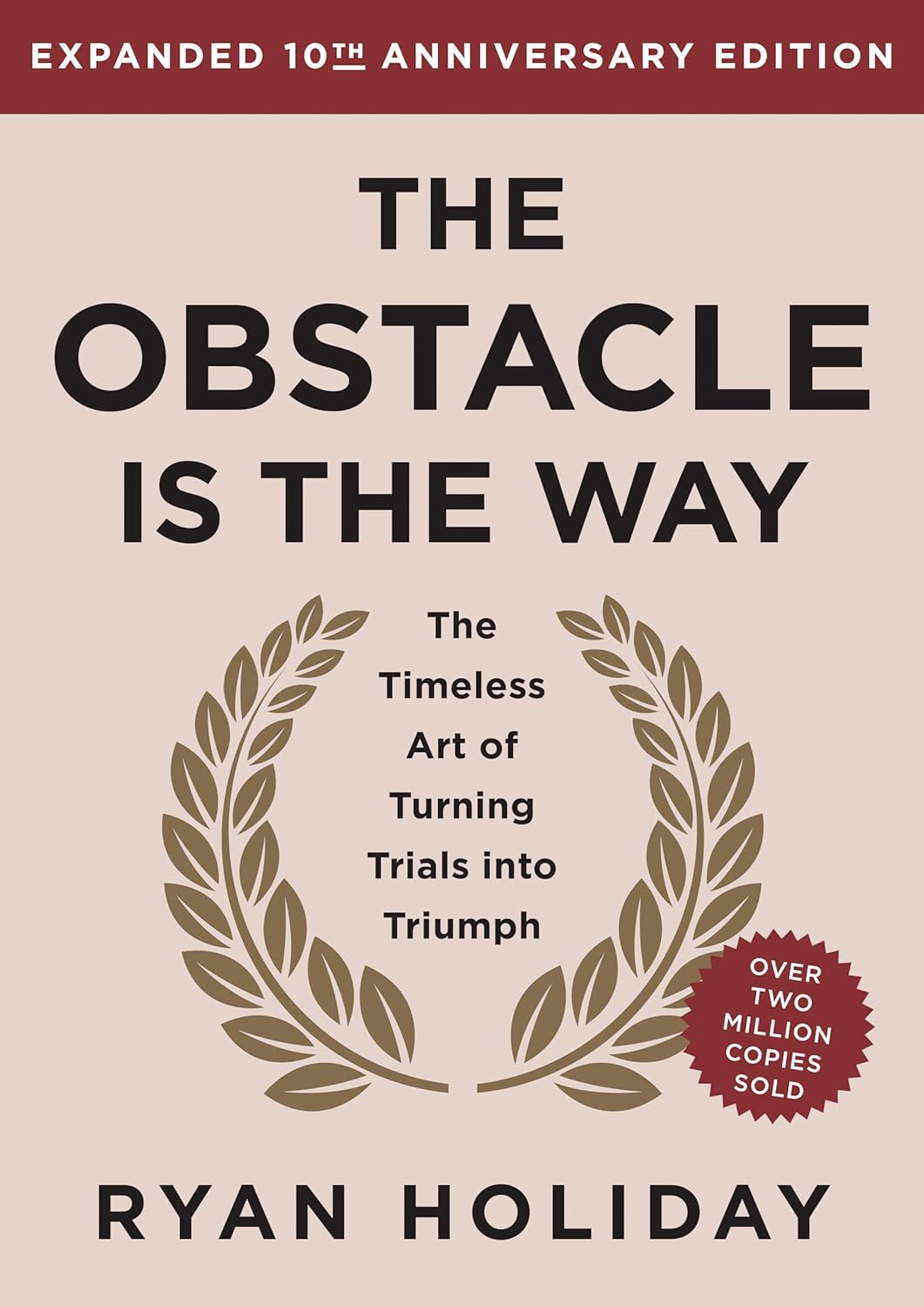
by Ryan Holiday
Source book · ~4h read
Pairing
The Obstacle Is the Way is paired with the Persistence stage — the one who lasts beats the best. It also speaks to Purpose.
Working draft
This summary is an early draft, still being checked for accuracy against the source. Treat it as a work in progress — not a verified reference — until this notice is removed.
The argument
Ryan Holiday renders Stoic philosophy into modern terms, built on the maxim the obstacle becomes the way: the impediment to action advances action; what stands in the way becomes the way. Every obstacle is composed of three things — the perception of it, the action you take in response, and the will you bring to enduring it. Master those three, and circumstance can't stop you.
At a glance
The hook
The next step looks like a wall. You've forgotten that walls are paths.
Founders confront obstacles weekly — a key hire backs out, a customer churns, a partnership falls through, a feature breaks at the worst time, an investor passes. The temptation is to interpret each one as signal about whether the venture should continue. Holiday's contribution is the Stoic reframe: the obstacle isn't external to the work; *the obstacle is the work*. The founder's job isn't to find a path with no obstacles; it's to develop the practice of converting each obstacle into the next step.
For first-time founders specifically, this book provides language and historical example for what otherwise feels like personal failing. You're not uniquely cursed; you're standing in front of the wall every meaningful builder has stood in front of. The discipline isn't optimism (which collapses under reality); it's perception, action, and will — three things you can actually train.
5 takeaways
01 / 05 — Discipline of perception
Use ← → keys, or swipe on mobile
Pick the single biggest obstacle in your business right now — something that, if it weren't there, the company would be obviously winning. Be honest; don't pick something small.
Now answer three questions, ten minutes each:
Perception — What story am I telling myself about this obstacle? What other equally-true story could I tell? (e.g., 'this customer churned because our product is broken' vs. 'this customer churned and gave me one specific reason I can address.')
Action — What is the smallest concrete action I can take in the next 24 hours toward this obstacle? Not solving it — just engaging with it. (e.g., 'send three customer-research emails' vs. 'fix retention.')
Will — If this obstacle takes 6 months instead of 6 days to resolve, am I prepared to keep showing up? If not, what would I need to change in my life so I am?
*The obstacle hasn't moved. But you've reframed it from 'thing in my way' to 'thing I'm working on.'** That reframe alone, repeated weekly, is most of what persistence actually feels like.*
Read
Share