Lone genius pose
- Wait for inspiration
- Innovation feels random
- Critique kills early ideas
- Solo work
- Quality over quantity
Pain · also: Product
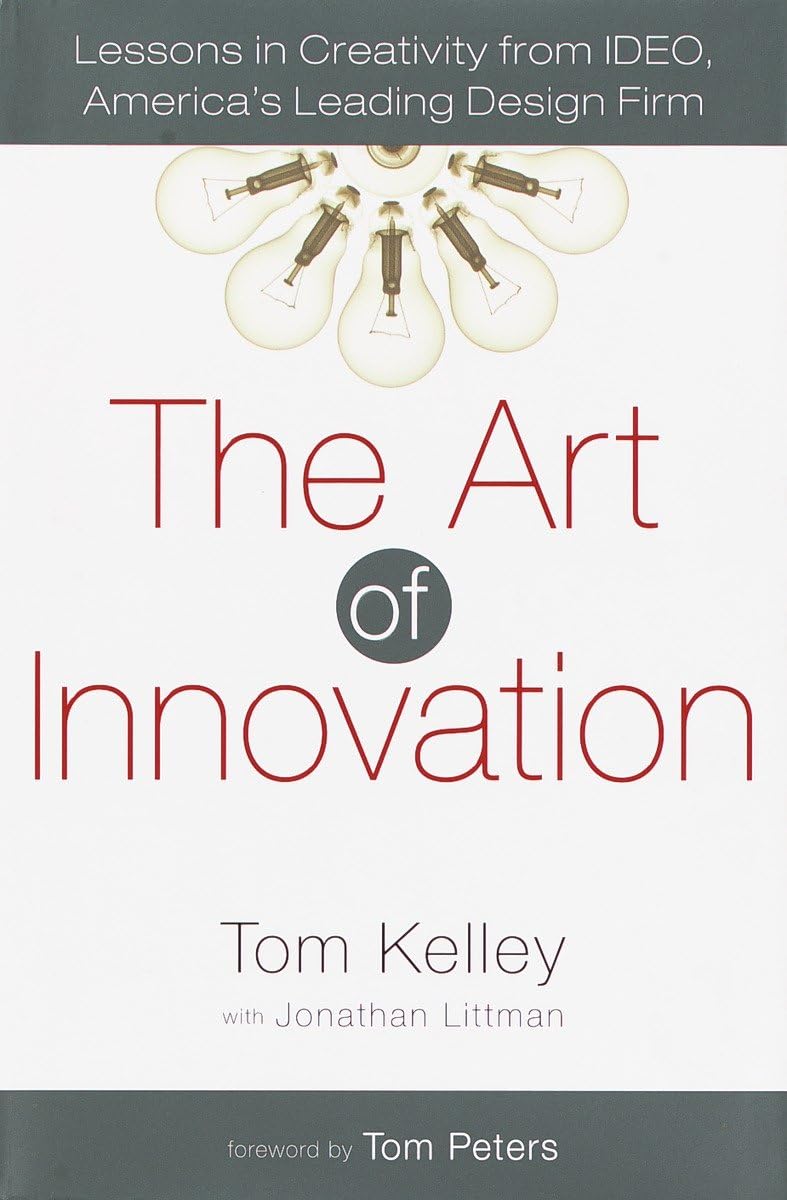
by Tom Kelley
Source book · ~5h read
Pairing
The Art of Innovation is paired with the Pain stage — fall in love with the problem, not the solution. It also speaks to Product.
Working draft
This summary is an early draft, still being checked for accuracy against the source. Treat it as a work in progress — not a verified reference — until this notice is removed.
The argument
Tom Kelley, IDEO's general manager, argues that innovation is not the product of individual genius — it's the result of a disciplined, observable, replicable process. The process: observation in context, brainstorming with rules, rapid prototyping, cross-functional teams, fast iteration. Most companies treat innovation as a mystical event; IDEO treats it as a method. The book is part case study, part operating manual.
At a glance
The hook
Creativity feels like a personality trait. Kelley shows it's a process.
Many first-time founders outsource creativity to a co-founder they assume is 'the creative one,' or they suffer privately because they think they're not creative enough. Kelley's contribution is dismantling the assumption. Innovation is observable, decomposable, and trainable — and the book shows specifically how, with rules.
The brainstorming rules alone are worth the read: defer judgment, encourage wild ideas, build on the ideas of others, stay focused, one conversation at a time, be visual, go for quantity. These aren't pleasantries; they're rules that, when violated, kill the brainstorm.
For first-time founders, this book makes innovation operational. Schedule observation hours. Run brainstorms by the rules. Prototype quickly. Bring in a cross-functional team early. The output isn't always brilliant; it's reliably better than what comes from the lone-genius pose. Reliable beats brilliant over a quarter.
5 takeaways
01 / 05 — Observation > assumption
Use ← → keys, or swipe on mobile
Pick one product or strategy problem you've been talking about for weeks without resolution. Schedule a 60-minute brainstorm with 3–5 cross-functional people.
Print the rules and read them aloud at the start:
Defer judgment — no criticism during the session, even of bad ideas.
Encourage wild ideas — the wilder the better. Wild ideas can be tamed; tame ideas can't be wilded.
Build on others — 'Yes, and...' not 'no, but...'
Stay focused — one topic; resist drift.
One conversation — no side conversations.
Be visual — draw, don't talk. Whiteboards, sticky notes.
Go for quantity — 100 ideas in 60 minutes. Quality emerges from quantity.
Run the session. Don't critique during it. Save evaluation for the next day.
The results will be 80% noise. The 20% signal is more than you'd have generated alone. That's the point — Kelley's method, applied weekly, compounds.
Read
Share