7P Framework
← Stories
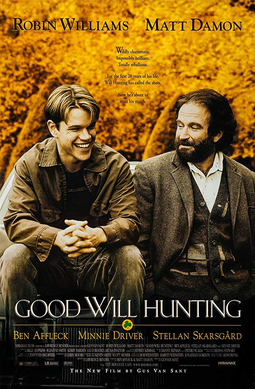
Poster for Good Will Hunting (1997)

People · also: Purpose

Good Will Hunting

Directed by Gus Van Sant · written by Matt Damon, Ben Affleck

Film · 1997 · 2h 6m

Starring Matt Damon, Robin Williams, Ben Affleck, Minnie Driver.

Find streaming options ↗

It's not your fault.
Sean Maguire (Robin Williams), Good Will Hunting (1997)

Pairing

Why this story, in this stage

Good Will Hunting is paired with the People stage — who builds it with you determines whether it gets built at all. A model. It also speaks to Purpose.

The argument

Central thesis

Will is brilliant and broken. Brilliant in the way that wins MIT math competitions in his head while mopping the floor; broken in the way that survives childhood abuse by sealing every door before it can be slammed. The film's premise is that the gift isn't worth using if the one who has it can't be reached. Sean's job — a job he himself nearly walked away from after his wife's death — is to reach Will not as a patient but as a person.

The bench scene is the iconic delivery. Sean tells Will that everything Will knows from books, he doesn't actually know. You can read a thousand books on art and still not know what it smells like in the Sistine Chapel. The lesson is about lived experience as the only knowledge that matters on the questions that matter — how do I live, who do I love, what am I sealed against.

The "It's not your fault" scene that closes the film is the lesson on what real intervention looks like: not a frame, not a question, not a strategy. A truth held against a wall until the wall comes down. Sean repeats the line. Will deflects, then jokes, then resists, then breaks. The breakdown is the work.

For founders, the film is the canonical mentor story. The mentors who matter aren't the experts in the LinkedIn sense; they're the ones who've lived through what you're carrying and can call you out from a place of love.

The hook

The founder lesson

The mentors who change you aren't the ones with the most experience. They're the ones who've lived through what you're carrying — and can call you out from a place of love.

Three founder lessons.

First, brilliance protects against growth as efficiently as it protects against intimacy. Will doesn't need to grow because he's already smarter than everyone in the room. The film's argument: if your gift lets you avoid the conversations you'd otherwise have to have, the gift is also the cage. Founders whose competence is so high that no one challenges them eventually stop growing. The brilliance becomes a wall.

Second, mentorship isn't expertise. Sean isn't the smartest psychologist in the film. He isn't even the most credentialed. He's the only one who lived the loss Will is sealed against. That's the qualification. For founders looking for mentors, the LinkedIn instinct — find the most successful founder you can — usually misses the point. The mentor who can reach you is the one who's been where you are, not the one who's where you want to go. They're often three years ahead, not thirty.

Third, real intervention is repetition. Sean says it's not your fault once, and Will deflects. Twice, and Will jokes. Three times, and Will resists. Four times, and the wall starts to crack. The lesson is that the truth a person needs to hear isn't delivered in a single perfect sentence — it's held against the wall until the wall comes down. Founders who deliver hard truths to their teams and expect them to land on the first delivery are skipping the work. The work is the repetition, with patience, from a place of love.

5 takeaways

What to remember

  • Your gift is visible whether you're using it or not

    Will solves the math problem on the hallway chalkboard while no one's looking. Founder analog: the work you'd do without a paycheck or an audience is the work the world will eventually find. The visibility isn't the question; the question is whether you'll let yourself be seen for it.

  • Lived experience is the only knowledge that matters

    "You can read a thousand books on art and still not know what it smells like in the Sistine Chapel." *Founder analog: pick mentors who've been there, not mentors who've read about there.*** The credential that matters isn't the exit; it's the lived hour.

  • Real intervention is repetition

    Sean says it's not your fault until the wall comes down. Founder analog: the truth a team member needs to hear doesn't land on the first delivery. Hold the line, with patience, from love. Most founders give up after one attempt and conclude the person can't hear it.

  • "I had to see about a girl"

    Will leaves the corporate offer and drives to California. Founder analog: the priority that changes everything is rarely the priority on your roadmap. Permission to follow it — when you know — is part of the work.

  • The note at the end

    Sean opens his door and finds the note. "Sorry, I had to go see about a girl." The choice Will makes is only possible because Sean did the work to make him capable of it. Founder analog: the work of mentorship is invisible until the person walks through the door it opened.

Practice CardOne-screen exercise

Find your Sean.

Sean isn't a domain expert; he's someone who lived through what Will is sealed against. *Identify one person who has lived through what you're carrying right now — not who knows about it from observation, but who's been in it.*

A founder who shut down their company. A founder whose co-founder left. A founder who lost a key hire and rebuilt. A founder who hit founder-depression and came back. A founder whose marriage paid the cost of the company.

Reach out this week with a single specific question, not a coffee chat. 'You shut down [company]. What did you wish someone had told you in the month before you decided?' Most replies will be generous. Most won't reply if you don't ask.

If you can't think of anyone who's lived through it, that's the data — your network is too narrow for what you're carrying. The Mentors surface on this site exists for exactly this reason. Start there.

Share with a founder who's deciding whether to keep going.