7P Framework
← Stories
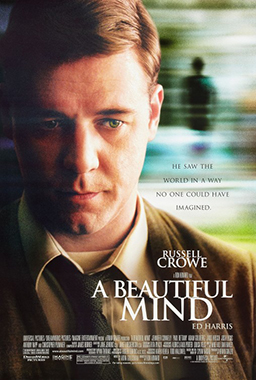
Poster for A Beautiful Mind (2001)

Persistence · also: Purpose

A Beautiful Mind

Directed by Ron Howard

Film · 2001 · 2h 15m

Starring Russell Crowe, Ed Harris, Jennifer Connelly, Paul Bettany.

Find streaming options ↗

It is only in the mysterious equations of love that any logical reasons can be found.
John Nash (Russell Crowe), A Beautiful Mind (2001)

Pairing

Why this story, in this stage

A Beautiful Mind is paired with the Persistence stage — the one who lasts beats the best. A model. It also speaks to Purpose.

The argument

Central thesis

Howard's film about John Nash takes a long-disease story and renders it as a long-purpose story. Nash develops paranoid schizophrenia in his thirties; the hallucinations cost him his career, nearly his marriage, and decades of cognitive fluency. The film's structural choice — to render Nash's hallucinations as visually identical to his real perceptions — forces the audience to feel what Nash feels: the inability to tell what's real. When the truth is finally named, the work begins not to cure the illness (it doesn't go away) but to learn to live with it functionally.

For founders, A Beautiful Mind is the canonical mental-health film. The romantic founder narrative pretends the cost is grit and grit alone; the actual cost is often diagnosable. The film lets founders see their own private struggle named on a screen — the paranoia about the team, the magical thinking about the funding round, the inability to sleep, the sense that something in your perception isn't trustworthy — without judgment, without aphorism, and with the long arc of someone who lasts.

The hook

The founder lesson

The romantic founder narrative pretends the cost is grit. The actual cost is often diagnosable. A Beautiful Mind is the film about the long arc of someone who lasts anyway.

Three founder lessons.

First, naming the thing. For most of the film, Nash's illness has no name; he interprets the hallucinations as a covert assignment from the government. Naming it — schizophrenia — is the work that makes everything afterwards possible. Founders carrying private anxiety, depression, or burnout often spend years interpreting the symptoms as character flaws, weak focus, lack of grit. Naming the thing is not weakness; it is the precondition for every move that follows.

Second, Alicia. The marriage holds, barely, through the worst years. Jennifer Connelly's performance is the film's quiet center: she doesn't fix Nash, she doesn't leave him, she doesn't pretend he's fine. She stays in the room. For founders, Alicia is the proof that the closest relationship matters more than the institutions when the institutions can't see what's actually wrong with you. The institution sees a tenured professor, a Nobel laureate, a successful man. The marriage sees the actual person.

Third, the technique. The film's deepest founder insight is in how Nash specifically manages the hallucinations: he learns to recognize them but not engage them. He sees Charles, Parcher, Marcee — they follow him, age with him, never go away. He just doesn't talk back. For founders carrying chronic anxiety, perfectionism, the inner critic, the impostor voice — this is the technique. You don't have to silence the voice; you have to stop talking back. The voice can be present; the action doesn't have to bow to it.

The Nobel speech at the end is the long-arc payoff. Not because Nash won — he wins — but because the work of staying long enough to be at the podium is itself the lesson. Most founders don't get to the podium. The film's argument is that the discipline is to keep being someone who could.

5 takeaways

What to remember

  • The chalkboard — the gift survives the perception failing

    Nash keeps doing math even as his sense of reality breaks. Founder analog: the work itself is often more durable than the founder's perception of the work. Trust the discipline of the work over the mood of the day.

  • The hallucinations — find someone whose perception you trust

    Nash can't tell what's real; Alicia can. *Founder analog: when you can't trust your own perception, find one person whose perception you do trust and check the read with them before acting.* Co-founder. Spouse. Therapist. The Joanna from the Steve Jobs film.

  • Alicia stays — closest relationship as the ground

    She doesn't fix him, doesn't leave, doesn't pretend he's fine. Founder analog: when institutions can't see what's wrong with you, the closest relationship is the only ground. Don't lose them by treating good day at work as the metric for good day in the marriage.

  • Naming the illness — diagnosis as precondition

    Nash can't manage what he hasn't named. Founder analog: the symptom you've been calling a character flaw might have a clinical name. Naming it isn't weakness; it's the precondition for every move that follows. Most founders skip this step for years.

  • The Nobel speech — the long arc

    The work of staying long enough to be at the podium is the lesson. Most founders never get there. Founder analog: the discipline isn't to win; it's to keep being someone who could. The podium is downstream of decades of not stopping.

Practice CardOne-screen exercise

Name the thing.

Take ten minutes. Write down the symptom you've been calling a character flaw.

I can't focus. I can't sleep. I'm catastrophizing. I'm short with the team. I lose my temper at small things. I check email at 3 AM and can't stop. I cry in the car. I can't remember the last time I felt joy at work.

Now: is there a clinical name for what you're describing?

Anxiety. Depression. Burnout. ADHD. PTSD. Hypomania. Don't self-diagnose — the exercise isn't to land on a label. The exercise is to consider that what you're carrying might have a name.

If it does, the next move is a professional — not a pep talk, not a self-help book, not another year of telling yourself to try harder. Most founders skip this step for years. Nash's life shortened until he didn't. Naming the thing is the move.

A note for founders who think this doesn't apply: the thing about diagnosable symptoms is that the people carrying them are usually the last to notice. Your closest relationship — your Alicia — sees it first. Ask them.

Share with a founder who's deciding whether to keep going.