WHAT first
- 'We make X for Y customers'
- Buyer compares features and price
- Loyalty depends on competitive offer
- Talent decides on compensation
- Hard to differentiate
Purpose
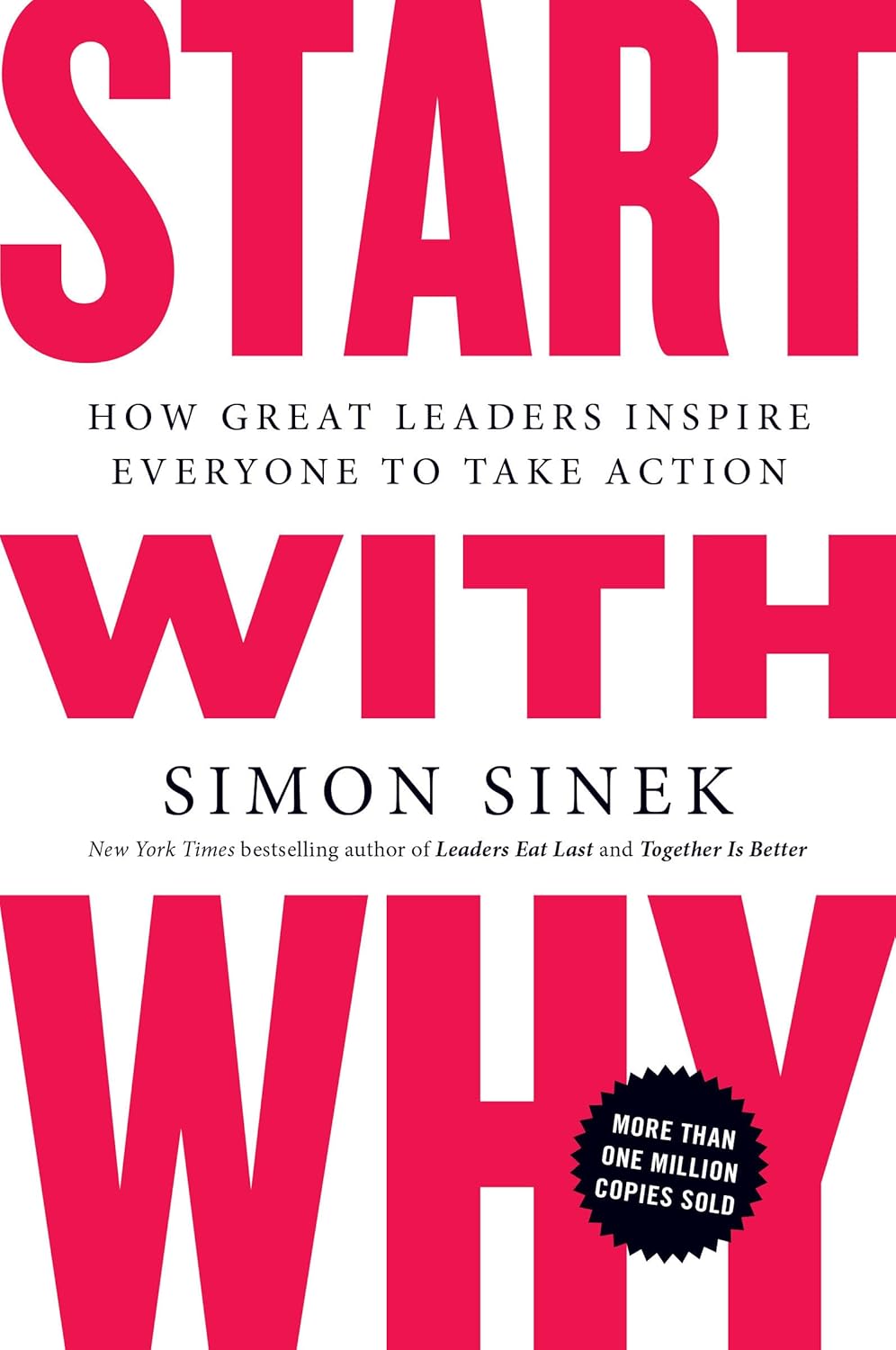
by Simon Sinek
Source book · ~4h read
Pairing
Start With Why is paired with the Purpose stage — the reason you start, and the reason you survive.
Working draft
This summary is an early draft, still being checked for accuracy against the source. Treat it as a work in progress — not a verified reference — until this notice is removed.
The argument
Simon Sinek argues that the most enduring leaders, organizations, and movements communicate from the inside out — starting with WHY they exist (the cause / belief), then HOW they do it (the differentiated process), then WHAT they offer (products / services). Most companies operate in the reverse — leading with WHAT — and never connect with anyone deeply enough to inspire loyalty.
At a glance
The hook
Most founders explain what they do brilliantly. Almost none can answer the why in one sentence.
Sinek's frame matters most for first-time founders because *the WHY is the only durable answer to 'why should the best people work with you instead of someone established?'** It's the same answer to 'why should I buy from you instead of the cheaper alternative?' and 'why should I keep going when this gets harder than I expected?'*
WHAT can be copied; HOW can be reverse-engineered; WHY is the only piece that's structurally yours. Founders who can't articulate it lose talent to companies that can. Founders who can articulate it get the talent for free — because the people who already believe what you believe self-select toward you.
5 takeaways
01 / 05 — The Golden Circle
Use ← → keys, or swipe on mobile
Take 15 quiet minutes. Answer in one sentence — not a paragraph, one sentence:
*'We exist to ___ so that ___.'*
The first blank is the action / contribution; the second is the impact.
'We exist to help small businesses look professional online so that they can compete with bigger companies they could outwork.'
'We exist to make co-founder relationships measurable so that founders can address fit problems before they become company-killing problems.'
If your WHY contains the words 'best,' 'fastest,' or 'most innovative' — that's a WHAT pretending to be a WHY. Rewrite.
If your WHY could plausibly be your competitor's — it's not specific enough. Rewrite.
Now test it: read it aloud to one person who knows you well and one person who doesn't. Do they nod or do they look confused? If both nod, you've got your WHY. Use it in every pitch, hire interview, and team conversation for the next year.
Read
Share