Conventional / 'rational'
- Lead with logic and BATNA
- Find the middle ground
- Avoid emotion
- 'Yes-and-build' approach
- Win-win as goal
People · also: Pain · Profits
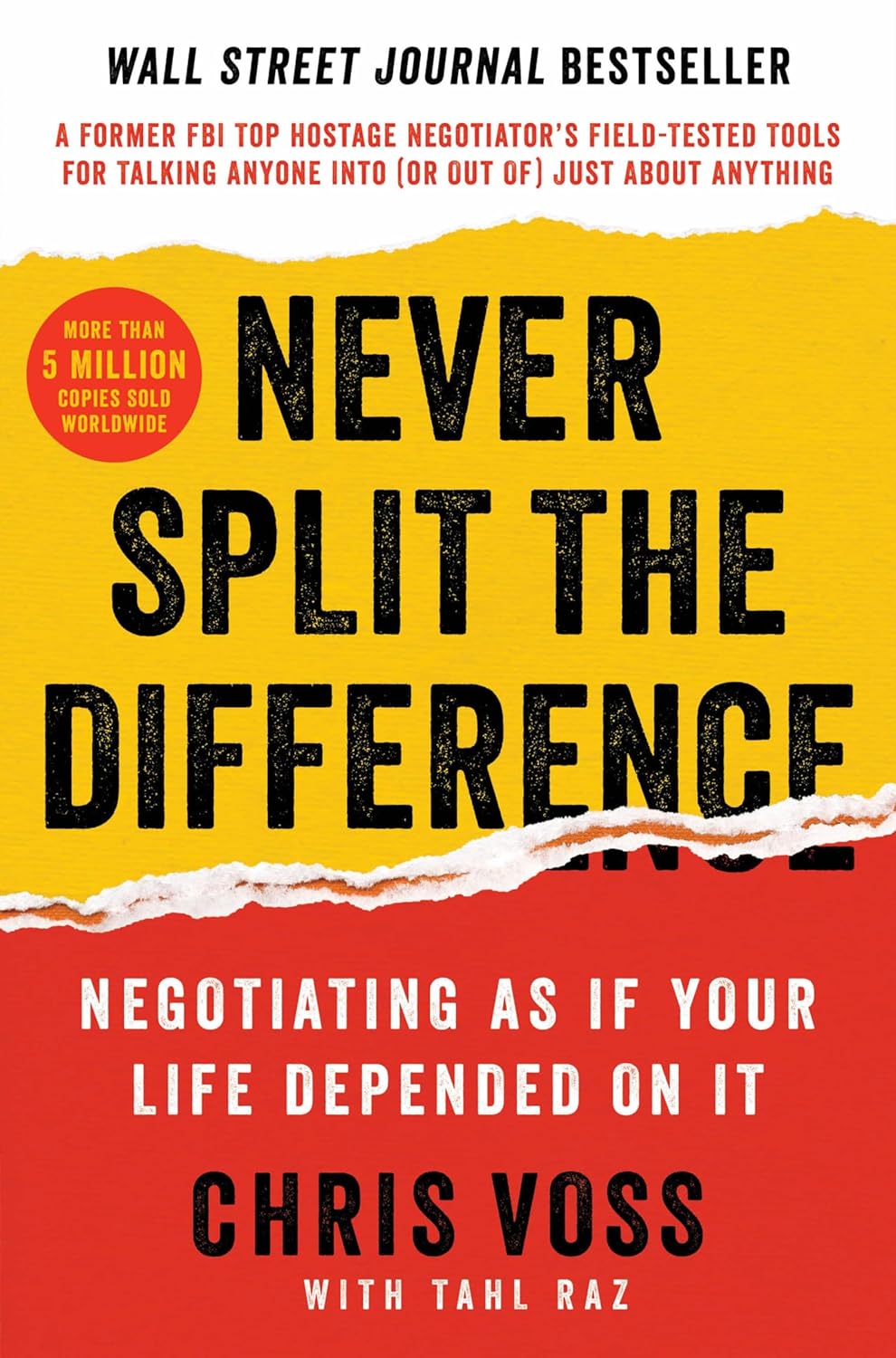
by Chris Voss
Source book · ~5h read
Pairing
Never Split The Difference is paired with the People stage — who builds it with you determines whether it gets built at all. It also speaks to Pain and Profits.
Working draft
This summary is an early draft, still being checked for accuracy against the source. Treat it as a work in progress — not a verified reference — until this notice is removed.
The argument
Chris Voss, former FBI hostage negotiator, argues that *the conventional wisdom of negotiation — 'meet in the middle,' 'find win-win,' 'be rational and analytical' — fails in real, high-stakes negotiations because human beings aren't rational, they're emotional. Effective negotiation is tactical empathy — understanding the other side's emotions and worldview, then using that to shape outcomes. The goal isn't compromise; it's collaboration on a deal that genuinely works for both sides, often by uncovering things the other side didn't realize they wanted*.
At a glance
The hook
The cliché 'win-win negotiation' is a story founders tell themselves to feel okay about losing.
Founders negotiate constantly — investor terms, customer contracts, vendor deals, co-founder splits, salary discussions, partnership agreements. The cost of being mediocre at negotiation isn't visible per-deal; it compounds over years. The investor who shaved 5 points off your valuation, the customer who got 30% off, the hire who got 10% more equity — each one is small alone; together they're significant.
Voss's contribution is making negotiation a learnable skill rather than a personality trait. The techniques — mirroring, labeling, calibrated questions, the 'no' that opens conversations — are concrete and immediately usable. For first-time founders, the highest-ROI skill investment is often becoming meaningfully better at negotiation — and this is the book that gets you started.
5 takeaways
01 / 05 — Mirror the last 3 words
Use ← → keys, or swipe on mobile
Pick one upcoming negotiation this week — a customer call, an investor email response, a vendor discussion, a salary conversation. Anything where you'll be talking with someone about terms or trade-offs.
Before the conversation, plan three calibrated questions you could ask:
'What about this is important to you?'
'How am I supposed to do X given Y constraint?'
'What's the biggest challenge you're facing on this?'
During the conversation, mirror the last 3 words of every important statement they make. Just repeat them with curious inflection. Don't follow with anything — let them keep talking.
At one point, deliberately label an emotion you're sensing: 'It seems like you're concerned about ___.'
Notice what changes. You'll get more information than you ever have in past negotiations, and the other side will feel more heard, not less. That's tactical empathy in action — and the deal almost always gets better as a result.
Read
Share