Vision-led
- Wait for the big idea
- Brainstorm in a vacuum
- Trust intuition
- 'Disrupt' as goal
- Genius is rare; most don't get one
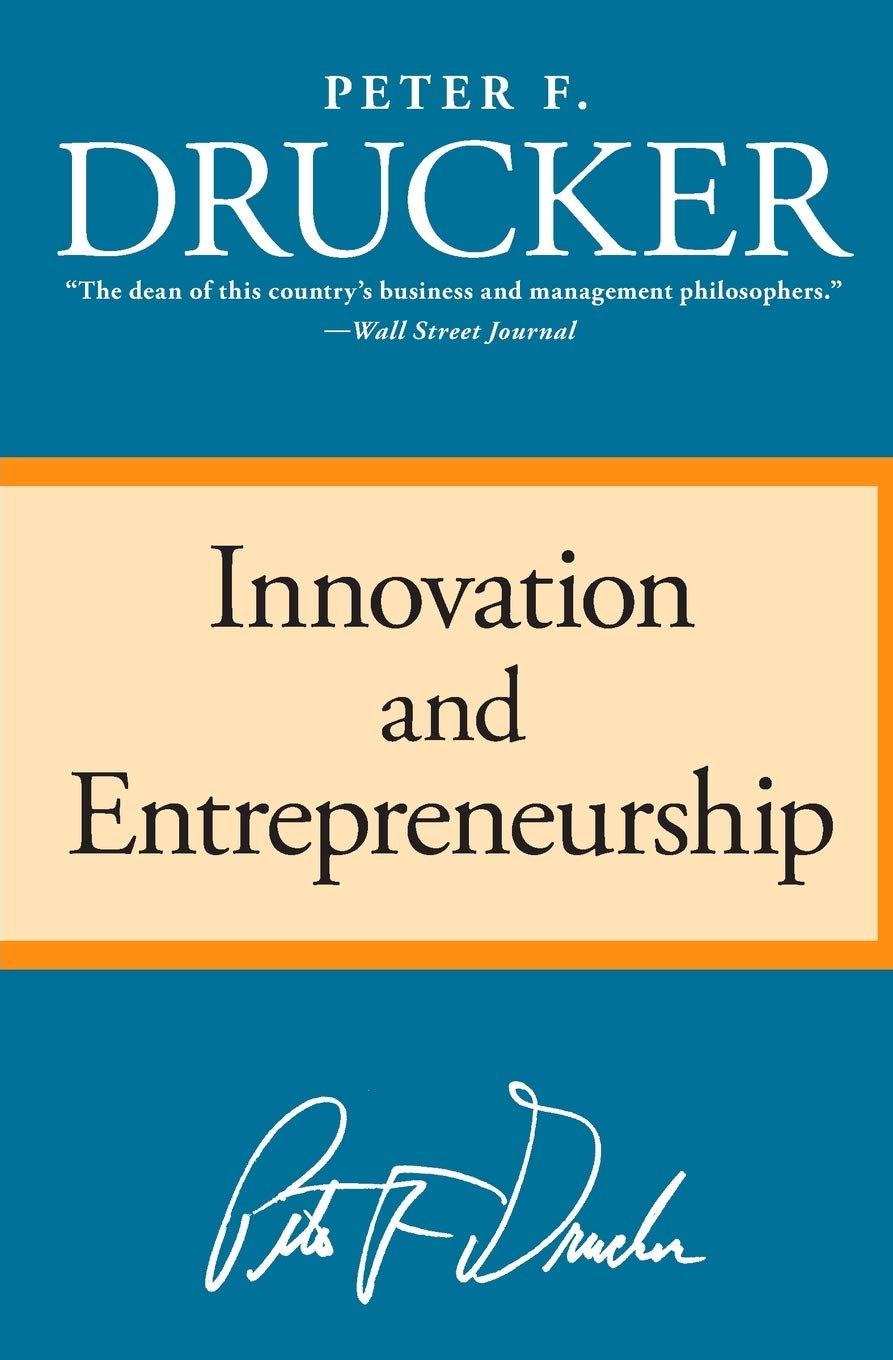
Pain · also: Prove
by Peter Drucker
Source book · ~6h read
Pairing
Innovation and Entrepreneurship is paired with the Pain stage — fall in love with the problem, not the solution. It also speaks to Prove.
Working draft
This summary is an early draft, still being checked for accuracy against the source. Treat it as a work in progress — not a verified reference — until this notice is removed.
The argument
Peter Drucker argues that innovation is not a magical, mysterious gift — it is a discipline that can be learned and practiced. Most successful innovations come from systematic exploration of seven sources: unexpected occurrences, incongruities, process needs, industry/market changes, demographic shifts, changes in perception, and new knowledge. Drucker's claim is striking: 'genius' innovation is rare; the rest is methodology — and the methodology is teachable.
At a glance
The hook
'Opportunity' feels mystical. Drucker makes it discoverable.
First-time founders often suffer from idea-anxiety: the belief that successful entrepreneurs have a special kind of insight that they themselves lack. Drucker's contribution is dismantling that myth. He argues — with detailed historical evidence — that most successful innovations are responses to predictable signals in the environment, not flashes of genius.
For first-time founders, this book provides a systematic search procedure. The seven sources of opportunity are observable, discoverable, and frequently visible. An unexpected success at a competitor (source 1). An incongruity between what consumers want and what's offered (source 2). A clearly bottlenecked process (source 3). Most ideas come from these. Most founders aren't trained to look. Drucker trains the looking — and once you're trained, opportunity becomes systematic, not lottery-like.
5 takeaways
01 / 05 — Innovation is a discipline
Use ← → keys, or swipe on mobile
Pick one industry you know well — your own, an adjacent one, or one a friend works in. Don't try to brainstorm ideas; instead, walk through Drucker's seven sources methodically.
For each source, ask: what do I observe in this industry that fits this category?
Unexpected occurrences — what's working surprisingly well? What's failing surprisingly badly? Examples often hide here.
Incongruities — what's a gap between how something should work and how it actually works? The customer's experience vs. industry assumption.
Process needs — what's a known bottleneck everyone has worked around for years? Often visible to insiders, invisible to outsiders.
Industry/market changes — what's structurally different about this industry compared to 5 years ago? Mergers, regulatory shifts, scale changes.
Demographics — who's in this market that wasn't 5 years ago, and what do they need?
Changes in perception — what's changed in how customers see this category, even if the product hasn't changed?
New knowledge — what new capability (technical, scientific) makes something newly possible?
For each source, write 1–2 specific observations. You'll likely find at least 2–3 viable opportunities you'd never have brainstormed your way to. That's Drucker's discipline at work.
Read
Share