Bad strategy
- Lists of goals
- Rallying cries
- 'Be the best at X'
- Many priorities, none ranked
- Actions don't reinforce each other
Prove
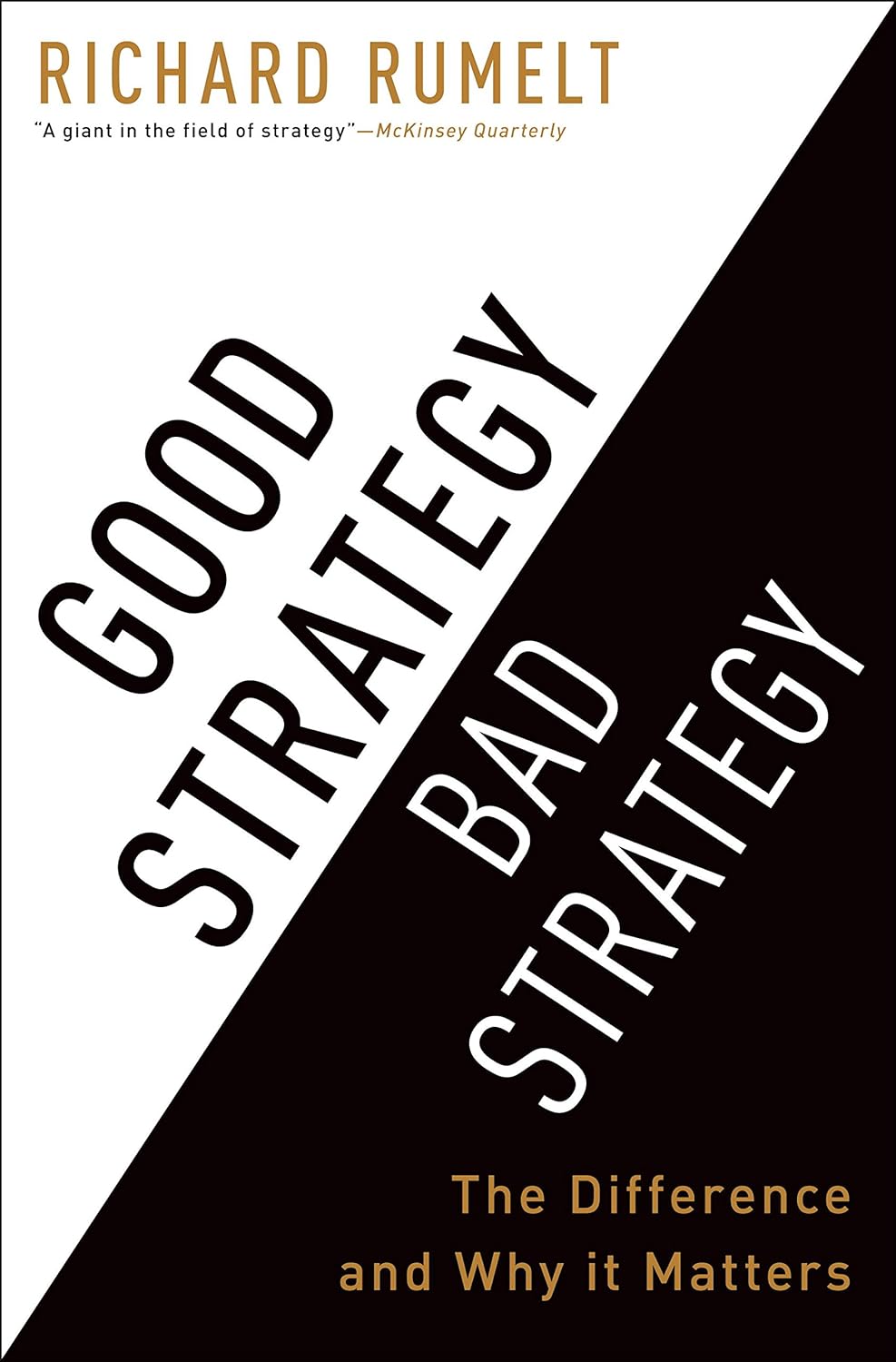
by Richard Rumelt
Source book · ~5h read
Pairing
Good Strategy, Bad Strategy is paired with the Prove stage — the market is the only judge that matters.
Working draft
This summary is an early draft, still being checked for accuracy against the source. Treat it as a work in progress — not a verified reference — until this notice is removed.
The argument
Richard Rumelt argues that most 'strategy' documents aren't strategy at all — they're lists of goals, rallying cries, or generic ambitions ('be the best,' 'create shareholder value'). Real strategy has three parts (the kernel): a diagnosis of what's actually going on, a guiding policy for addressing the diagnosis, and a set of coherent actions that follow from the policy. Bad strategy mistakes goals for strategy; good strategy turns insight into decisions.
At a glance
The hook
Most strategy documents are wishlists pretending to be plans.
First-time founders confuse three different things and call them all 'strategy': goals (where we want to go), slogans (how we sound when we say it), and action plans (what we'll do this quarter). Rumelt's contribution is naming the difference. A real strategy starts with a diagnosis of why the situation is what it is — usually a specific problem or opportunity that the company is uniquely positioned to address — and follows with coherent actions that all reinforce each other.
For a Phase 1 founder, the value is brutal clarity. 'We will be the best-in-class platform for X' fails the diagnosis test — it's a goal. 'Mid-market customers buy bundles, not features, and incumbents can't unbundle without cannibalizing their flagship — so we ship a focused bundle priced below their flagship' — that's a strategy. The kernel is a discipline that makes weak strategies look weak before they cost you a year.
5 takeaways
01 / 05 — The kernel
Use ← → keys, or swipe on mobile
Take your current strategy document — pitch deck, OKR doc, whatever serves as the company's strategic statement. Print it. Now read it through Rumelt's three-part filter:
Diagnosis — does it explain what's actually going on? Why is the market structured this way? Why is now the right time? Why are incumbents missing this? Or does it just describe the goal?
Guiding policy — is there a clear approach to addressing the diagnosis? Not a goal — a policy. For example: 'We will compete on bundling, not features' (policy) vs. 'We will be the best-in-class platform' (goal).
Coherent actions — do the specific actions in the doc reinforce each other? Or are they a portfolio of disconnected initiatives — each pursuing a different theory of the market?
If any of the three is missing, you have a goals-list, not a strategy. The fix isn't more bullets; it's stripping the goals-list down to the one thing the diagnosis points to. Rewrite using the kernel — even if the result is shorter than what you started with. Especially if it's shorter.
Read
Share