Non-essentialist
- Yes by default, no requires defense
- More projects = more progress
- Trade-offs hidden, all options open
- Calendar fills passively
- Energy = scattered across many
Persistence
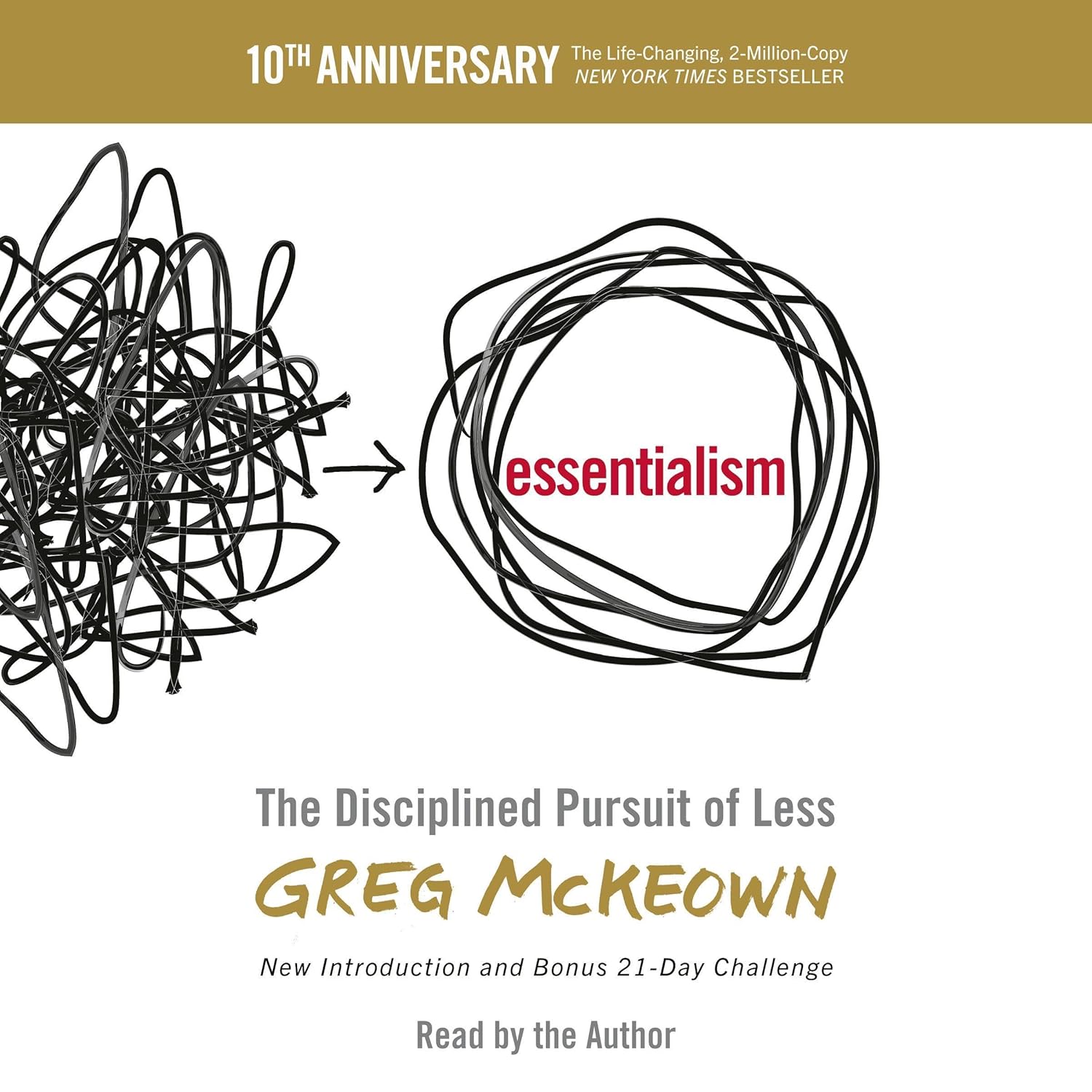
by Greg McKeown
Source book · ~3h read
Pairing
Essentialism is paired with the Persistence stage — the one who lasts beats the best.
Working draft
This summary is an early draft, still being checked for accuracy against the source. Treat it as a work in progress — not a verified reference — until this notice is removed.
The argument
Greg McKeown argues that modern productivity culture has trained us to chase 'more' — more features, more goals, more meetings — at the cost of doing anything actually well. Essentialism is the disciplined pursuit of less but better: ruthlessly distinguishing the vital few from the trivial many, and saying no to almost everything so you can say a real yes to what matters.
At a glance
The hook
Your week is full and your progress is empty. The fix isn't time management — it's subtraction.
Founders are trained to say yes. Yes to the meeting, the partnership, the feature, the founder dinner, the new market, the customer asking for an integration. Each yes seems harmless individually. The cost compounds invisibly until your week is full and the company isn't moving.
McKeown's contribution is permission to subtract. The vital few — the 2–3 things that actually move the company forward this quarter — get crowded out by the trivial many. The discipline isn't time management (which assumes everything must fit). The discipline is deciding what doesn't fit and removing it. For a first-time founder, the highest-leverage skill is often the willingness to disappoint people in the short term to compound something real in the long term.
5 takeaways
01 / 05 — Less, but better
Use ← → keys, or swipe on mobile
Pull up your last seven days. List every meeting, project, and obligation you put time into. Be honest — include the ones that felt productive but didn't move anything.
Now circle the 2 to 3 items that, if you'd done only those things and let the rest fail, would have been the most valuable week of your year.
Look at what you didn't circle. Why did you spend time on it? Common answers: 'they asked me directly,' 'I didn't want to disappoint,' 'it felt urgent.' None of those are 'this was vital.'
The practice: for the next two weeks, when something hits your calendar that isn't a clear circle-worthy thing, say no — politely, briefly, without apology. 'I can't make this work right now' is a complete sentence. The discomfort lasts a day. The reclaimed time compounds for a quarter.
Read
Share