Reactive
- 'Should I do X or not?'
- Confirm initial intuition
- Decide while feeling
- Commit blindly
- Find out late if wrong
Persistence
by Chip & Dan Heath
Source book · ~5h read
Pairing
Decisive is paired with the Persistence stage — the one who lasts beats the best.
Working draft
This summary is an early draft, still being checked for accuracy against the source. Treat it as a work in progress — not a verified reference — until this notice is removed.
The argument
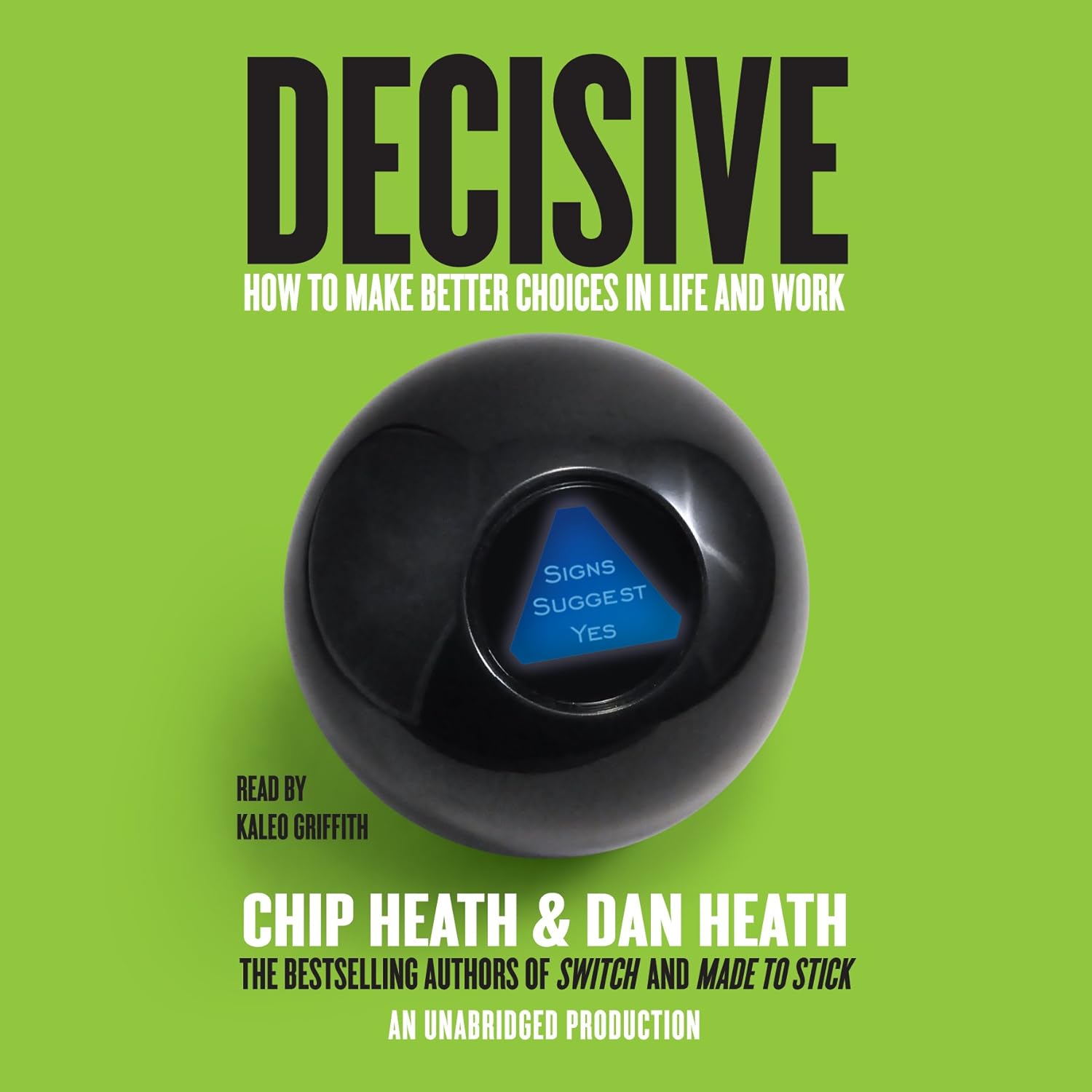
Chip and Dan Heath, after surveying decision research, identify four 'villains' that systematically corrupt decisions: narrow framing (limiting options to a binary choice), confirmation bias (seeking evidence for what we already believe), short-term emotion (deciding from temporary feelings), and overconfidence (assuming we know more than we do). The antidote is the WRAP framework: Widen your options. Reality-test your assumptions. Attain distance before deciding. Prepare to be wrong.
At a glance
The hook
The four villains of decision-making keep ambushing you in the same week.
Founders make consequential decisions weekly: should we hire this person, ship this feature, take this round, exit this customer. The Heath brothers show that even good intentions don't protect you from the four villains — they're cognitive biases, not character flaws.
The WRAP framework — Widen, Reality-test, Attain distance, Prepare to be wrong — is the structured antidote. Most founder decisions go straight from problem to solution without the four steps. Widening means generating real alternatives, not validating one option. Reality-testing means seeking disconfirming data, not confirmation. Attaining distance means using time, perspective, or external advisors to escape short-term emotion. Preparing to be wrong means acknowledging uncertainty in advance, not after the fact.
For first-time founders, the value is operational. Run any consequential decision through WRAP, and you'll catch most villains before they cost you. Most decisions feel like they require speed; in reality, they require structure.
5 takeaways
01 / 05 — Widen your options
Use ← → keys, or swipe on mobile
Pick one consequential decision you're facing this week — a hire, a strategic choice, a major customer ask.
Widen — List 3–4 real alternatives. Not 'do X or don't.' Genuinely different options. 'Do X with caveats. Do Y instead. Wait 30 days and reassess. Do nothing.'
Reality-test — What evidence would convince you the option you're leaning toward is wrong? Find that evidence before deciding. Run a small experiment if possible.
Attain distance — Use the 10/10/10 rule. How will you feel about this in 10 minutes? 10 months? 10 years? Different timescales reveal different aspects. Or: if a friend brought you this exact choice, what would you advise them?
Prepare to be wrong — Define what 'wrong' looks like. What signal would tell you the decision was bad? Set a check-in date. Pre-commit to a response if the signal arrives.
Now decide. The decision quality is dramatically higher because you've passed it through the four villains' antidotes. Run this on every consequential decision; the cost is 30 minutes, the benefit is years.
Read
Share